
Risk-Based Preventive Conservation and Decision Support for Sustainable Heritage Management: The HERIe Platform
By: Aldo Manzo
Abstract
Preventive conservation is increasingly challenged by the need to reconcile long-term preservation with sustainability, climate change adaptation, and institutional constraints. Traditional rule-based environmental standards, while historically influential, often fail to address the complexity, diversity, and uncertainty inherent in cultural heritage environments. This article presents a risk-based framework for preventive conservation that emphasises value loss, probability, and impact rather than strict compliance with fixed environmental thresholds. Within this context, the HERIe (Heritage Risk Evaluation) digital platform is introduced as an integrated decision-support system that operationalises quantitative risk assessment across multiple deterioration mechanisms. By combining environmental data analysis, material-specific damage functions, and scenario comparison, HERIe supports informed, transparent, and sustainable conservation decisions at strategic, tactical, and operational levels.
Introduction
Cultural heritage preservation operates at the intersection of material vulnerability, social value, and environmental change. Preventive conservation aims to limit deterioration before irreversible loss occurs, yet the question of how long and at what cost heritage should be preserved remains unresolved. Increasingly complex collections, historic buildings, mixed-use spaces, and climate-driven risks expose the limitations of prescriptive conservation standards that assume uniform material behaviour and stable environmental control.
Human decision-making under uncertainty is further shaped by cognitive biases, particularly risk aversion and loss avoidance. These tendencies can lead a disproportionate focus on narrowly defined environmental risks while neglecting more significant, though less frequent, threats such as fire or flooding. Risk-based preventive conservation responds to these challenges by providing a structured framework that prioritizes actions according to their potential to reduce value loss over time.
From Rule-Based Standards to Risk Management
Conventional preventive conservation has long relied on predefined temperature, relative humidity, light, and pollution limits applied broadly across collections. While effective in controlled museum environments, such approaches are often impractical or unsustainable in historic buildings and complex institutional contexts. They may also encourage energy-intensive solutions that are misaligned with contemporary sustainability goals.
Risk management reframes preventive conservation as the management of change rather than the elimination of all variability. Its primary objective is not absolute safety but the protection and creation of value. This approach, widely adopted in fields such as engineering and healthcare, has been adapted to cultural heritage through the work of researchers who emphasize value loss, probability, and impact as the basis for conservation decision-making. Within this framework, damage is understood as a cumulative and probabilistic process rather than a binary outcome.
Value, Significance, and Conservation Choices
Heritage value is multifaceted, encompassing cultural significance, meaning, use, and future potential. Conservation actions inevitably shape these dimensions by enabling or restricting access, interpretation, and use. Preventive conservation can therefore be understood as a form of benefit–cost management, in which institutions seek to minimize value loss at a defined future point while accounting for financial, environmental, and social costs.
Recognizing that preservation often entails deferred access allows institutions to make more transparent and defensible decisions. Rather than aiming for universal optimal conditions, risk-based approaches support differentiated strategies tailored to object sensitivity, significance, and patterns of use.
Damage Mechanisms and Risk Assessment
Risk-based preventive conservation addresses a wide range of deterioration processes acting over different timescales. Mechanical damage arises from handling, vibration, structural movement, and environmental fluctuations. Although theoretical models often predict high sensitivity to relative humidity changes, empirical evidence shows that many objects have survived centuries of variability without active damage.
Risk assessment therefore distinguishes between historic, proven fluctuations to which objects have acclimatised and new conditions that exceed past experience. For objects that have ‘acclimatised’ to the environment within which they have been preserved for a long time, the safe range of humidity is determined by the largest past RH fluctuations. It is generally accepted that the risk of physical damage beyond that already accumulated in the past is extremely low, as long as fluctuations do not exceed the historic climate (Michalski). HERIe tends to overestimate mechanical risk for the majority of objects in the collection except for new objects or objects that have undergone extensive conservation. Chemical degradation affects materials such as paper, textiles, leather, plastics, parchment, metals, and glass. These processes are cumulative and often irreversible, driven by temperature, humidity, pollutants, and intrinsic material instability. Gaseous and particulate pollutants contribute to corrosion, soiling, and chemical degradation. Sources include outdoor air, building materials, display furniture, and deteriorating objects themselves. Risk depends on concentration, exposure duration, material sensitivity, and enclosure performance. Pollution risk assessment integrates air exchange rates, adsorption capacity, and emission sources to evaluate mitigation options such as filtration, sorbents, or improved enclosure design.
Light-induced damage, particularly fading, is governed by cumulative exposure, spectral distribution, and material sensitivity. Risk-based light management evaluates expected color change over defined time horizons, enabling object-specific exposure policies that balance access and preservation. Pollution risks, including gaseous corrosion and particulate soiling, depend on source strength, air exchange, material sensitivity, and enclosure performance, encouraging targeted mitigation rather than blanket filtration.
Biological risks such as insect infestation and mould growth are strongly influenced by environmental conditions, housekeeping, and building fabric. Low-probability, high-impact catastrophic risks—such as fire, flooding, or structural failure—consistently dominate overall risk magnitude despite their rarity, challenging the traditional emphasis on narrow environmental control.
Decision Support and Digital Tools
Risk assessment provides the analytical foundation for decision-making, but its value lies in practical application. Conservation decisions occur across institutional levels, from long-term strategic planning to daily operational choices. Effective decision support must translate complex scientific data into understandable metrics, accommodate uncertainty, and allow comparison of alternative scenarios while integrating sustainability considerations.
Digital decision-support systems address these needs by enabling transparent evaluation of risks and mitigation options. They support alignment between conservation objectives, institutional priorities, and broader societal responsibilities, including energy reduction and climate action.
The HERIe Platform
HERIe has been developed by an international consortium including the Jerzy Haber Institute PAS, Canadian Conservation Institute, University College London, English Heritage, and the Getty Conservation Institute. By mid-2025, the platform had attracted over 3,000 users and more than 200,000 calculations, demonstrating broad adoption. This software is not a replacement for professional judgment; rather, it enhances transparency, consistency, and evidence-based decision-making in preventive conservation.
HERIe is a digital platform developed through international collaboration to support risk-based preventive conservation. Structured around the agents of deterioration, it integrates environmental monitoring data, quantitative risk assessment, and material-specific damage models into a unified framework. The platform addresses mechanical damage, chemical degradation, light exposure, pollution, fire risk, and micro-climate performance, enabling users to compare conservation scenarios and mitigation strategies.
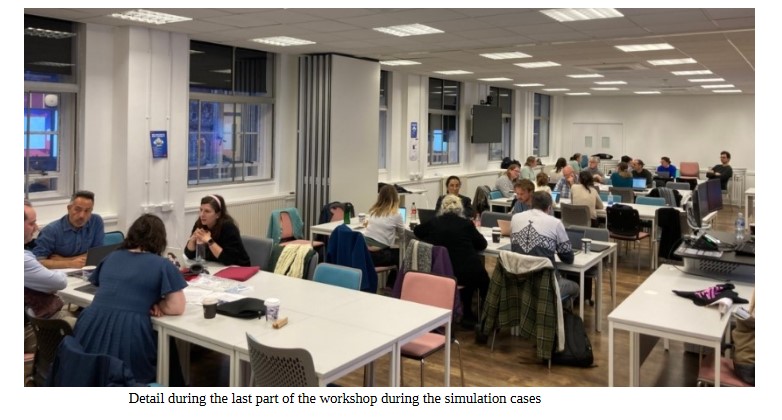
Herie modules are base on the 10 agents responsible of lost in cultural heritage. At the moment the software can run 5 of them in the Tool section and the others tests are in working process. [AT1] HERIe upports application at strategic, tactical, and operational levels. At the strategic level, it assists institutions in identifying dominant risks and evaluating long-term scenarios related to building interventions, climate strategies, or policy changes. At the tactical level, it supports teams in prioritizing collections, assessing environments, and designing proportionate mitigation measures. At the operational level, it enables object- and space-specific analysis based on monitored data and defined use patterns.
Crucially, HERIe functions as a decision-support tool rather than an automated decision-maker. Professional judgement remains central, with the platform enhancing transparency, consistency, and reproducibility.
After creating your profile users can access the tools, tutorial, environmental data, demonstration data (used during training), ‘About’, and ‘Contact’ sections.
This article focuses on the conceptual aspects of risk assessment and preventive measure to protect cultural heritage materials rather than serving as a full software user guide.
The software includes a built-in “Tutorial” section that provides step by step guidance for each tool, parameters, algorithms, and diagrams, as well as direct contact with the creators of the software free of charge.
HERIe accepts environmental data in CSV format. As monitoring sensors often record data in different formats and column orders, files must be conferted accordingly (e.g. RH-T Date or Date-RH-T) prior to upload.
Once the environmental simulation based on the material category (most commonly paintings on canvas, wood, textiles, or paper), the software generates diagrams illustrating each scenario. These outputs can be downloaded or exported for sharing. In certain modules, it is possible to focus directly on improving environmental stability. For example, buffering strategies can be evaluated by calculating the quantity of materials such as Art-Sorb required for a given volume. Similarly, airflow rates within a display case or room can be modelled to assess the influence of contaminants on deterioration rates and collection lifespan.
By modelling these parameters, conservators can better understand the environmental risks and make informed, sustainable decisions that balance preventive conservation needs with practical and energy-efficient solutions.
Sustainability and Environmental Control
Environmental control remains one of the most energy-intensive aspects of heritage management. Evidence from long-term monitoring and modelling demonstrates that significant reductions in energy use and carbon emissions are achievable without compromising preservation outcomes. Adaptive strategies—such as seasonal set points, passive buffering, humidistatic heating, or targeted micro-climates—can often deliver equivalent or superior risk reduction compared to rigid control.
HERIe supports these approaches by enabling scenario comparison and quantification of benefits, facilitating informed decisions about when intensive systems are justified and when lower-impact solutions are sufficient.
Conclusions
Preventive conservation is undergoing a fundamental transformation driven by the need to manage complexity, uncertainty, and sustainability. Risk-based, value-oriented approaches provide a coherent framework for prioritising threats and designing proportionate responses. By focusing on probability, impact, and value loss, they move conservation practice beyond precautionary over-control toward adaptive and resilient strategies.
The HERIe platform operationalises this shift by integrating scientific models, environmental data, and decision-support tools within a single digital environment. Its application across institutional levels supports transparent, evidence-based, and sustainable heritage management. Together, risk assessment and digital decision support represent a critical step toward safeguarding cultural heritage in a changing world.
Overall, risk management for collections reframes preventive conservation as a strategic, evidence-based practice. By prioritising relative risk and value over absolute standards, it enables heritage professionals to make defensible, proportionate, and cost-effective decisions that support both long-term preservation and the responsible use of collections.